
Case StudyAI & ContentAugust 2026

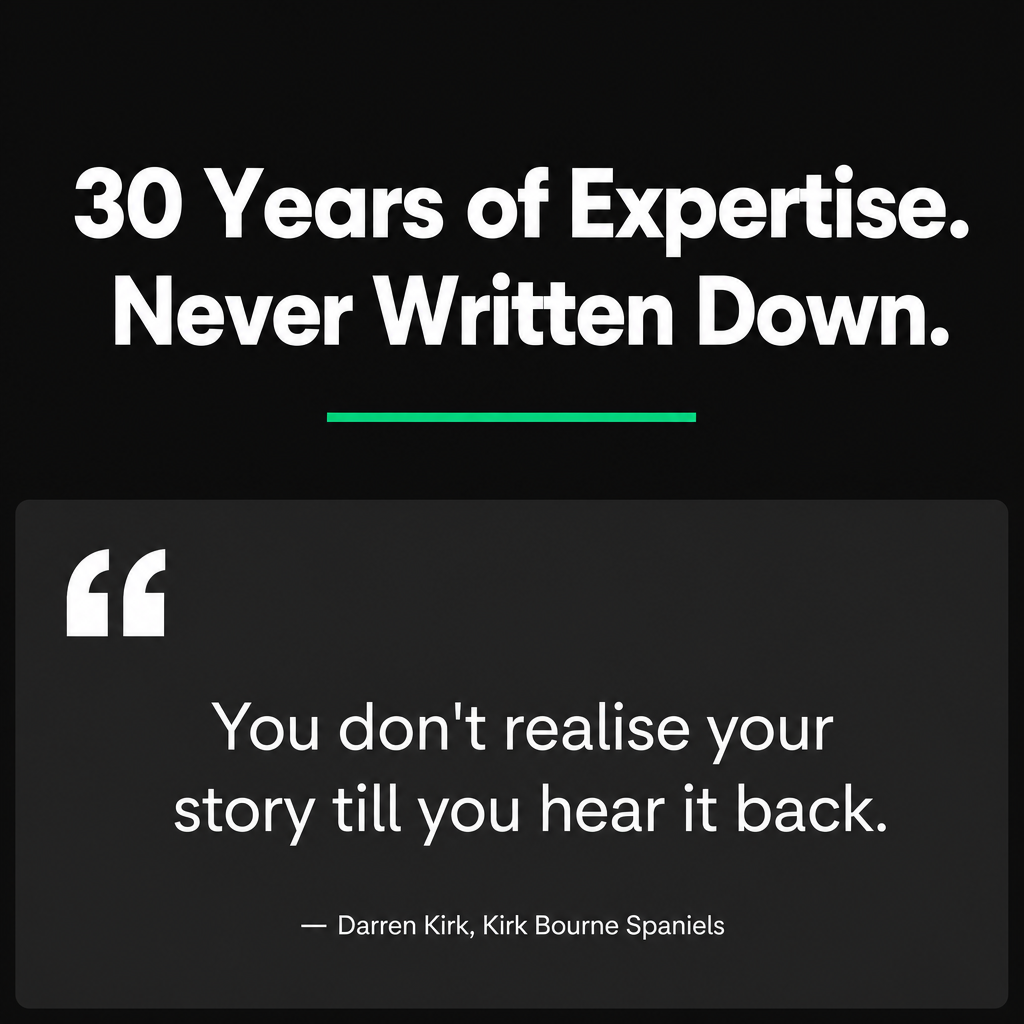
30 Years of Expertise. Never Written Down. Until Last Week.

Darren Kirk, a two-time UK Gundog Trainer of the Year with over 30 years' experience, had never documented his vast knowledge until he partnered with Decodefy. This case study explores how his unique expertise was finally captured and expressed, transforming his business's online presence.

Darren Kirk, UK Gundog Trainer of the Year, with Bryony Cameron at Kirk Bourne Spaniels training session

The short version

  1. Expert businesses often struggle with expressing their deep knowledge in a clear, written form.
  2. Generic AI content tools like ChatGPT may not capture the unique voice and specific details of an expert.
  3. A structured approach can extract an expert's story and methods, creating authentic and engaging content.

Darren Kirk has been training gundogs for over 30 years.

He's won UK Gundog Trainer of the Year twice - 2018 and 2023. He has more than 1,000 paying members across three venues in Yorkshire. When a new session slot opens, 178 people have been known to be watching online, waiting. Three minutes, and it's gone.

Five of his local competitors trained under him first.

And until last week, he'd never written any of it down.

Not a word.

The Problem Wasn't Expertise

That's the thing about expert businesses. The problem is almost never what they know. Darren Kirk knows things about gundog training that most trainers won't figure out in a career. He has, by his own account, over 150 ways to stop a dog on a whistle. He shows clients five. The other 145 exist for the moments when the five aren't enough - and most trainers hit their ceiling before they've realised there is one.

The expertise was never the problem.

The problem was expression. The mechanism to take 30 years of hard-won, specific, completely unrepeatable knowledge, and get it out in a form that does it justice. A form the right people actually find. A form that earns trust before someone has set foot in one of his fields.

Darren didn't have that. Most expert businesses don't.

His business partner Bryony Cameron - an ex-Army Major who joined Kirkbourne in 2019 and runs the events, manages social media, and does the thousand things that turn a brilliant trainer into a functioning operation - put it plainly during our first session: "I tried for hours to be able to write stuff. I get quite frustrated."

They'd tried ChatGPT. Got something back that was close enough to see the shape of what they wanted, but not close enough to publish. Too smooth. Too generic. No Darren in it. They stopped.

So the content gap stayed open. A 6,000-strong mailing list. No blog. No story. An online presence that gave away almost nothing of what made the place extraordinary.

What Changed in One Session

Our first training session with Darren and Bryony started, as they all do, with a proper conversation. Not a questionnaire. Not a content calendar. A conversation - the kind where you ask someone about their dogs and end up hearing about a corrupt field trial judge, a first night with 14 people in a field, and the moment they realised they'd quietly built something remarkable.

All of that went in. The origin. The methodology. The voice. The specific things Darren says that no one else says - like the fact that in 30-plus years, he's never failed a dog. That the problem is always the person on the other end of the lead, and he'll tell you that directly because the alternative is treating the wrong problem for six months.

Then the system started to work.

Within the same session, we produced a full rewrite of one of their product descriptions - their 6mm heel lead. A direct-response piece that opened with the line: "This lead isn't going to train your dog. You are." Bryony's reaction: "Did you hear that? It's cool."

Then ten Facebook ads from a single product description. Different angles - cold audience, credentials-led, social proof, gift-buyer, Darren's blunt voice direct to camera. Bryony identified several she wanted to use immediately. Jon's note at the time: "To get this written by someone who creates ads, you're looking at hundreds of pounds for what we've just done in five minutes."

Bryony's response: "Short, isn't it? But then I'd never have written this."

And then the pillar post. Darren's full origin story - working-class Yorkshire, the quarrying years, the competition circuit, the corrupt judge, the night 14 people showed up and something clicked. Three thousand words. Section by section, building the arc from who he was before all of this to what Kirkbourne Spaniels is now.

I read it back to them as it came together.

Bryony - who knows this story better than anyone, who has heard Darren talk about these things over years - said: "It keeps you hanging, doesn't it? I know the story, and I'm still hanging on the next bit."

That's the moment. Not the output itself. The recognition - the slight disbelief - that something you know inside out can still surprise you when it's expressed properly for the first time.

What "Expressed Properly" Actually Means

I want to be clear about something, because it matters.

Decodefy didn't create Darren Kirk's expertise. Didn't invent his story. Didn't write fiction dressed up as biography. Every line of that pillar post came from things Darren has actually done, actually said, actually lived. The corrupt judge. The 14 people. The 150 ways to stop a dog on a whistle.

What the system did - what it's built to do - is extract what's already there and express it at the standard it deserves.

That's a different thing from content generation. And it's a different thing from what raw AI tools do.

ChatGPT, Claude, Gemini - they're all working at the model level. They've learned patterns from everything ever written, and they reproduce those patterns fluently. Grammatically correct. Structurally sound. Completely indistinguishable from ten thousand other businesses using the same prompts. And here's the thing that frustrates me, genuinely - business owners know. They feel it immediately. They look at the output and think, that's not quite me. They just don't know why, so they go back and try better prompts. Which doesn't fix it. Because the problem isn't the prompt. It's what's underneath.

Bryony felt it the moment they tried. "No one else sounds like this," she said - talking about what they wanted their content to eventually be. The generic output wasn't that.

The AEC Fractal Framework® works above the model entirely. It's not a prompt layer. It's not a template. It's an architecture built from studying how expert human copywriters actually think - and it runs through every piece of output at three levels simultaneously. The whole business strategy, the individual piece, and the sentence itself.

That's why the first output sounds like Darren. Not almost like him. Like him on his best day, with the clearest thinking, and all the time in the world to say it right.

The Bit That Often Gets Missed

Most clients come to Decodefy for content - LinkedIn posts, blogs, product descriptions. They stay because of everything else.

In the same session where we wrote a pillar post and ten Facebook ads, we identified the Google Search Console setup Kirkbourne needed to understand which keywords were already bringing people to their site. First position for "rabbit training ball," as it turns out - their lowest-margin product. A detail worth knowing, and worth fixing. We pulled verbatim customer reviews into the system. We discussed the 40 colour combinations available on their leads - a differentiator Bryony mentioned almost as an aside, a throwaway comment that became the pivot point of the entire product rewrite.

One small piece of real context. Completely transformative output.

That's the compounding effect in practice. Month one, the system is good. Month six, it knows the voice, the clients, the specific language that converts. The small details that get mentioned in passing become the content that stops the scroll.

The Thing Darren Said

At the end of the session, as we were wrapping up, I read back a section of the pillar post - the part about the first night, 14 people, a field, a whistle, and a quiet suspicion it might work.

Darren's been training dogs his entire adult life. He knows this story. He was there.

He listened. And then: "You don't realise your story till you hear it back."

That's it, really. That's the whole thing.

The expertise was always there. The story was always there. The reputation, the results, the reasons someone should choose Kirkbourne Spaniels over the dozens of alternatives - all of it, always there. Thirty-odd years of it.

He just hadn't had a way to say it. Until last week.

If that sounds familiar - if you've been doing this for years and the content still doesn't quite sound like you - [this is what a first session with Decodefy looks like]. It takes about an hour. Everything after that is faster than what you're doing now.

Questions worth asking

What kind of businesses does Decodefy work best for?

Expert service businesses - the ones where the knowledge and reputation are real, but the content to show it consistently isn't. Gundog trainers, mortgage brokers, accountants, solicitors, coaches. If you've built something worth talking about and you're struggling to talk about it properly, that's who Decodefy is built for.

Is the content actually in your voice, or does it just sound similar?

The first output is what convinces people. Not an explanation of how it works - the output itself. Bryony's reaction in the first session: "It's like telling a true story about me, isn't it?" That's the standard we're working to. Not close. Right.

What does a first session actually produce?

It varies by business. In Kirk Bourne's case: a full product description rewrite, ten Facebook ads from one brief, the structure for a 3,000-word pillar post, and a clear content and SEO direction. In one session. At professional standard.

Does it work if you're not a natural writer?

That's exactly who it's built for. You talk to it like a person. The more context you give, the better the output gets. Writing ability isn't the requirement - knowing your subject is.

What happens to the content if I cancel?

Everything produced is yours. Cancelling doesn't delete two years of published work. You keep it all.

Ready to see it work in your world?

Book a Demo